
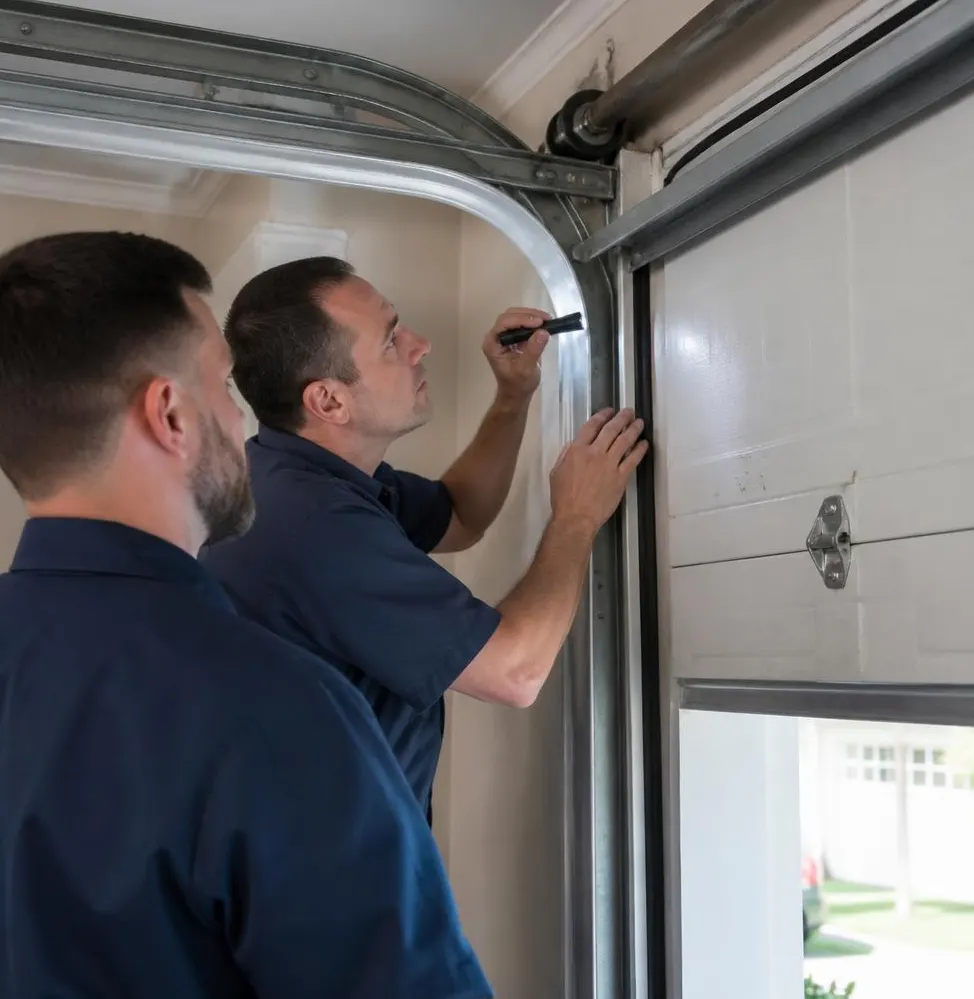
The Morning It Won't Budge
You hit the remote on your way to the car and the door groans halfway up, shudders, and stops. Or it rises an inch, you hear a faint tearing sound, and then it moves normally the rest of the way. Maybe the opener just hums for a second longer than usual before anything happens at all. None of this is dramatic enough to call it broken, but it's different from how the door behaved in August, and it's happening on the coldest mornings of the week.
Hemet and the surrounding valley don't get snow, but low-lying areas around San Jacinto, Winchester, and Valle Vista can drop close to freezing on clear winter nights, especially after a day of dry air. That's enough to cause real, repeatable symptoms in a garage door system that spent the summer baking in inland heat. Here's the order a technician works through when a homeowner calls in about a sluggish or stuck door.
1. The Bottom Seal Stuck to the Slab
This is the first thing worth checking, because it's the easiest to confirm yourself. The rubber weatherstrip along the bottom of the door can bond lightly to a concrete driveway or garage slab overnight when dew settles and the temperature drops. Add in the dust that collects on both the seal and the concrete during dry months, and you get a thin layer that grips just enough to resist the door's pull when the opener kicks on.
A tech will look for a line of residue or a slightly torn edge on the seal where it separated from the ground. The fix here is straightforward: inspect the seal for cracking or hardening, clean the contact strip on the slab, and replace the weatherstrip if it's gone stiff or brittle from UV exposure over the summer. A seal that's lost its flexibility will keep catching every cold morning no matter how clean the slab is.
2. Springs That Have Tightened Up
Metal contracts slightly in the cold, and torsion springs are no exception. A spring set that was balanced for summer temperatures can feel noticeably stiffer on a cold morning, which shows up as the opener straining, the door lifting unevenly, or the motor sounding like it's working harder than it should for the first cycle of the day.
This is checked next because it's a safety item, not just a comfort one. A technician will run the manual release and lift the door by hand to feel the resistance and check for even movement on both sides. If the springs are old, under-tensioned, or showing wear, this is where a spring replacement gets discussed rather than a temporary adjustment, since a spring that's already near the end of its cycle life is more likely to fail outright when it's working under added cold-weather tension.
3. Rollers and Hinges Moving Through Thickened Lubricant
Grease and lubricant don't flow the same way at 40 degrees as they do at 90. If the rollers and hinges were lubricated with a heavy grease back in spring, that same grease can turn gummy in cold weather, adding drag right at the points where the door needs to move most freely.
The check here is visual and physical: spinning each roller by hand, looking for grease buildup that's turned waxy or cracked, and checking the hinges for the same. The fix is a full clean of the old lubricant followed by a fresh application of a lubricant rated for a wider temperature range, something that stays workable through both the dry heat of summer and the cold snaps of a valley winter. This is a basic part of garage door maintenance that gets overlooked because the symptoms are subtle until a cold morning makes them obvious.
4. Opener Force Settings Fighting the Added Resistance
Every opener has force and limit settings that tell the motor how hard to push and how far to travel before reversing or stopping. Those settings get calibrated against the door's normal resistance. If the seal is dragging, the springs are stiffer, and the rollers are gummed up, the motor is suddenly fighting more resistance than the settings account for, which is often what causes the door to stop partway or reverse unexpectedly.
Once the mechanical causes above are addressed, a technician will check whether the force settings need a minor adjustment to match the door's current resistance. This is usually a quick fix, but it's checked after the mechanical issues, not before, since adjusting force settings to compensate for a stuck seal or stiff spring just masks the real problem and can wear out the motor faster.
5. Photo-Eye Sensors Fogged by Condensation
Last on the list, but worth a look if the door refuses to close at all rather than just moving slowly. The safety sensors near the bottom of the tracks can fog up on humid, cold mornings the same way a car windshield does, which reads as an obstruction and stops the door from closing.
The fix is simple: wipe both sensor lenses dry and make sure they're still aligned, since a bump from a parked car or stored item can throw off the alignment just enough to cause problems that look identical to a fogging issue.
When to Call Hemet Garage Door
If you've cleaned the seal and the door still sticks, or the opener strains every morning regardless of temperature, it's worth having it looked at before a cold snap turns a sluggish door into a stuck one. Hemet Garage Door handles both garage door maintenance, to get rollers, hinges, and lubrication back in shape for the season, and spring replacement, for doors that are clearly working harder than they should. We also run emergency garage door service for anyone whose door won't move at all on a cold morning and needs it open before the day gets going.
If your garage door is fighting you on these cooler mornings, give Hemet Garage Door a call. We serve Hemet, San Jacinto, Menifee, Murrieta, Temecula, Winchester, Sun City, and Valle Vista, and we can usually get a technician out the same day to sort out what's actually slowing your door down.